

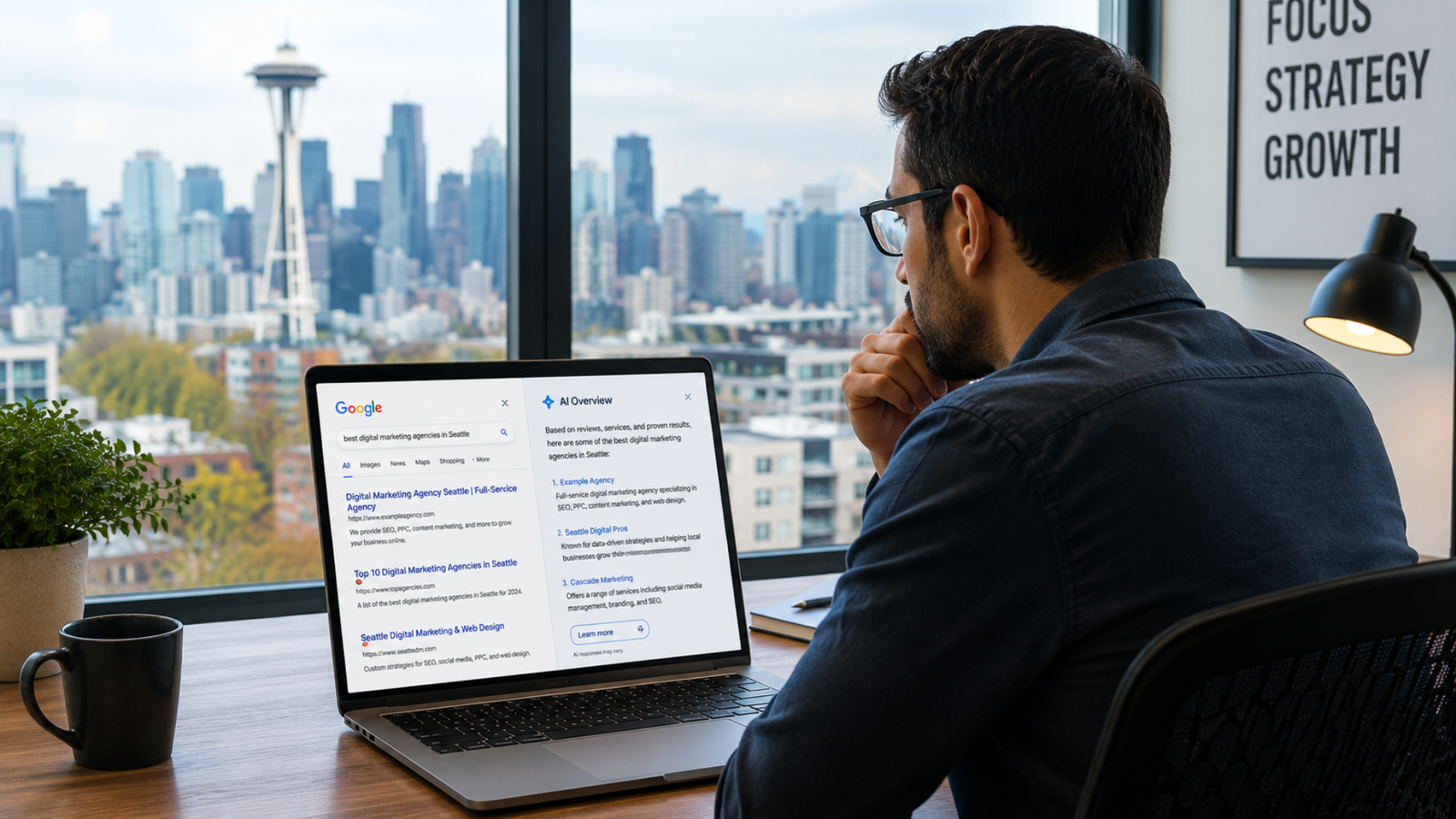
Something strange is happening to a lot of Seattle businesses right now. Their rankings look fine. Google Search Console shows stable impressions. But leads are down. Calls are down. And nobody can figure out why.
The way people find businesses has fundamentally changed. AI tools like ChatGPT, Perplexity, and Google AI Overviews are now answering questions directly, without sending the user to your website.
If you’re not the source AI pulls from, you’re invisible to a growing slice of your market. Choosing the right AI ranking agency in Seattle is a survival decision now. This guide will help you make it.
What “AI Ranking” Means (And Why It’s Different From SEO)
Traditional SEO was about getting your website to the top of Google’s blue-link results. That still matters. But it’s no longer the whole game.
The Zero-Click Reality Is Here
Right now, roughly 60% of searches end without anyone clicking a link. People ask a question. Google’s AI Overview answers it. The user gets what they need and moves on, without visiting any website, including yours.
The same thing happens on ChatGPT, Perplexity, and Gemini. Users ask,
“Who’s the best marketing agency in Seattle?”
“What should I look for in a GEO agency?”
And the AI gives an answer. That answer comes from sources the AI trusts, websites it’s crawled, content it can extract clearly, and brands with strong entity signals across the web.
If your business isn’t one of those trusted sources, you don’t exist in that answer. And that answer is where your buyer just made a decision.
What AI Ranking Involves
AI ranking, sometimes called Generative Engine Optimization (GEO) or AEO, is about making sure AI systems understand your business, trust it, and pull from it when answering relevant questions. That means a few things working together:
- Entity authority. AI models don’t just read your website. They look for consistent, verified signals across the web, your name, location, services, and expertise showing up reliably in places AI trusts. This is different from backlinks. It’s about being a recognized entity in the AI’s model of the world.
- Extractable content. AI systems need content they can actually pull from. That means clear, structured writing. Direct answers to real questions. Proper schema markup (LocalBusiness, FAQPage, Service, SpeakableSpecification). Content organized for machines, not just for human readers scrolling a page.
- Technical foundations. If your site is slow, messy, or poorly indexed, AI can’t read it reliably. SEO foundations aren’t dead, they’re more important than ever, because they’re what makes your site legible to the systems deciding who gets cited.
- Cross-platform visibility. Google AI Overviews, ChatGPT, Perplexity, and Gemini all cite differently. A real AI ranking agency tracks and optimizes for all of them, not just Google.
This is what separates a legitimate AI ranking agency from a traditional SEO agency that rebranded its website and added “AI” to its service list. And honestly, most of what you’ll find in Seattle falls into that second category.
What to Look For in an AI Ranking Agency in Seattle
If you’re evaluating agencies, here’s what actually separates the real ones from the rebrand.
They Measure AI Citation Share, Not Just Keyword Rankings
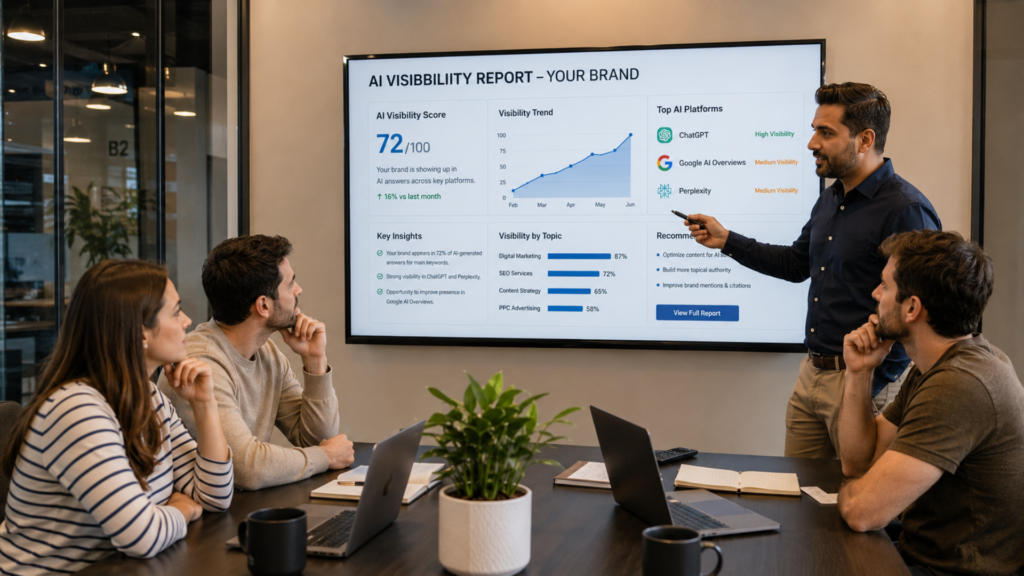
Any serious AI ranking agency tracks whether AI platforms are actually recommending your business. That means running automated prompt tests across ChatGPT, Perplexity, Gemini, and Google AI Overviews, and tracking your “Share of Model” over time.
If an agency shows up to your review meeting with a keyword ranking report and calls it AI visibility, walk away. Those are different things. Ranking on page one for a keyword doesn’t mean you’re being cited when someone asks ChatGPT,
“Who’s the best [your service] in Seattle?”
Ask directly:
How do you track whether ChatGPT and Perplexity are recommending our business?
If the answer doesn’t involve prompt testing across multiple AI platforms, keep looking.
They Have a Real GEO Methodology, Not AI Buzzwords
It’s extremely easy for an agency to say “AI-powered SEO” and mean absolutely nothing by it. The phrase has been emptied out by overuse. What you want to hear instead is specifics.
Ask them to walk you through their GEO process.
What schema types do they implement?
How do they structure content for machine extractability?
How do they build entity signals beyond your website?
What does the first 90 days actually look like?
A real agency can answer all of that without hesitation. An agency cosplaying as an AI shop will give you a lot of language about, “holistic digital presence” and “next-generation visibility frameworks” and nothing concrete.
They Understand Seattle’s Market Specifically
Seattle is a dense, tech-savvy market. You’re competing with SaaS companies, cloud infrastructure firms, biotech brands, and enterprise services, all fighting for attention from a buyer who’s more digitally sophisticated than average. What works for a home services company in Tulsa isn’t what works here.
A good Seattle AI ranking agency knows the local competitive landscape. They understand which industries are most saturated in local AI results. They’ve worked with Seattle-area businesses and can point to specific outcomes in this market. At (The Good Marketing Team), we only take 30 client partnerships at a time, exactly because this kind of market-specific attention is impossible to deliver at scale.
They’re Honest About Timelines
Meaningful AI citation results take 60 to 120 days minimum. Full authority-building is a 6 to 12-month process. Any agency promising you’ll be in ChatGPT’s recommendations within 30 days is either lying or showing you cherry-picked screenshots.
Real agencies set realistic expectations. They explain what the first quarter looks like (technical audit, content restructuring, schema implementation, entity signal building) and what the 6-month picture looks like (measurable citation frequency, competitive gap analysis, compounding authority signals). That’s the honest version of this timeline.
They Combine SEO Foundations With GEO Amplification
Here’s a mistake a lot of business owners make: they hear about GEO and think they can skip traditional SEO. You can’t.
AI systems need your site to be technically sound before they’ll trust it. Slow load times, poor site structure, missing metadata, crawl errors, these things don’t just hurt your Google rankings. They signal to AI models that your site isn’t a reliable source. You have to fix the foundation before you build the authority on top.
The best agencies don’t position SEO and GEO as competing services. They treat them as one system. The Good Marketing Team’s approach starts with SEO clarity, then layers GEO to make that clarity visible to AI systems, because one without the other doesn’t hold.
They Limit Their Client Load
This one sounds counterintuitive, but it’s a real signal. Agencies that take on 200 clients can’t give any of them the sustained attention that AI authority-building requires. GEO isn’t a set-it-and-forget-it campaign. It requires ongoing content building, entity reinforcement, prompt testing, and competitive analysis.
When an agency caps client partnerships and can tell you why, that’s a sign they understand what the work actually takes.
Red Flags to Avoid When Hiring an AI Ranking Agency in Seattle

This is the part most guides skip. So let’s be direct.
They Guarantee Specific AI Rankings
Nobody controls what ChatGPT recommends. No agency can guarantee you’ll appear in a Perplexity answer for a specific query. AI citation is earned through a disciplined process, not manufactured through tricks. Any agency guaranteeing specific AI rankings is being dishonest with you.
Legitimate agencies can guarantee effort, methodology, and reporting. They cannot guarantee citation outcomes. That distinction is important, and a trustworthy agency will make it clear upfront.
Their Case Studies Are Vague
“We increased traffic by 200%” is not a case study. It’s a claim. What you want to see is specific outcomes for specific clients: citation frequency improvement over time, Share of Model growth, AI platform coverage before and after, and ideally, how those visibility gains translated to actual leads or conversions.
If the agency can’t show you concrete evidence from real work, especially from businesses in Seattle or your industry, that’s a problem.
They Can’t Explain Their Process Without Jargon
When you ask how they actually do GEO work, you should get a clear explanation. If you’re hearing a lot of “proprietary frameworks” and “AI-native optimization ecosystems” without any actual process behind them, that’s a sign there’s no real methodology. It’s word salad with a premium price tag attached.
5 Questions to Ask Before You Sign With Any Seattle AI Ranking Agency
Before you commit to any agency, run through these. The answers will tell you almost everything you need to know.
1. How do you track AI citation share across platforms, not just Google rankings?
Listen for: prompt testing, Share of Model tracking, coverage across ChatGPT/Perplexity/Gemini.
2. Can you walk me through what the first 90 days of work look like, specifically?
Listen for: technical audit, schema implementation, content restructuring, entity signal building, and concrete deliverables with dates.
3. Do you have case studies from Seattle-area clients or businesses in my industry?
Listen for: specific numbers, industry context, and outcomes tied to AI visibility, not just traffic.
4. How do you approach SEO and GEO as a combined system?
Listen for: an understanding that SEO is the foundation and GEO is the amplification, not two competing services.
5. What do you realistically expect in terms of results, and over what timeframe?
Listen for: honesty. A 60 to 120-day timeline for early results, 6 to 12 months for compounding authority. Any answer shorter than that deserves skepticism.
How to Evaluate What AI Currently Says About Your Business
Before you even talk to an agency, go do this yourself. Open ChatGPT, Perplexity, and Google AI Overviews. Ask questions your target customers would ask:
“best [your service] in Seattle,”
“who do I call for [your specialty] in Seattle,”
“what should I look for in [your industry]”.
See if your business comes up. See who comes up. That gap between where you are and where you want to be is exactly what a good AI ranking agency should be closing for you.
At The Good Marketing Team, we offer a free AI audit that shows exactly how you’re currently being cited (or not cited) across the major AI platforms. It’s the clearest way to understand the actual problem before deciding what to do about it.
The Traditional Ranking Game Isn’t Over, But It’s No Longer Enough
AI systems are now the first stop for millions of buyers every day, and if your business isn’t being cited as the trusted answer, someone else is. Choosing an AI ranking agency in Seattle means knowing what to look for: real GEO methodology, AI citation tracking across platforms, honest timelines, technical SEO as the foundation, and a team that actually understands this market. It also means knowing what to avoid: agencies that rebrand without changing, vague metrics, and promises that no one can honestly make.
The businesses getting ahead right now aren’t waiting to see how AI search plays out. They’re building authority while others are still watching. If you want to understand exactly where you stand today, start with a free AI visibility audit from The Good Marketing Team. It takes two minutes and shows you the gap clearly. The answer window is open. The only question is whose answer fills it.
FAQs
1.What is an AI ranking agency?
An AI ranking agency helps businesses appear in AI-generated answers across platforms like ChatGPT, Google AI Overviews, Perplexity, and Gemini, not just traditional Google search results. They use Generative Engine Optimization (GEO), structured content, entity authority building, and technical SEO to make your business a trusted source for AI systems.
2.How is an AI ranking agency different from a traditional SEO agency?
A traditional SEO agency focuses on Google keyword rankings and organic traffic. An AI ranking agency also optimizes for how AI systems cite and recommend your business in generated answers, which involves different techniques, including schema markup, entity signal building, and cross-platform AI citation tracking.
3.How long does it take to see results from AI ranking optimization?
Meaningful AI citation results typically take 60 to 120 days, with compounding improvements over 6 to 12 months. Any agency promising results in under 30 days should be viewed skeptically.
4.What should I look for when choosing an AI ranking agency in Seattle?
Look for documented GEO methodology, AI citation tracking across multiple platforms, transparent reporting, realistic timelines, local Seattle market experience, and a clear approach that treats SEO as the foundation for GEO amplification.
5.What is Generative Engine Optimization (GEO)?
GEO is the process of structuring your content, entity signals, and technical foundations so that AI systems, including ChatGPT, Perplexity, Google AI Overviews, and Gemini, recognize your business as a trusted, citable source when answering relevant questions.
6. Do personal injury attorneys need to show up in AI search results?
Yes, and this is more urgent than most law firms realize. When someone searches “best personal injury attorney in Seattle” on ChatGPT or Perplexity, AI gives a direct answer. The firms being cited are winning those calls before a Google search even happens. Legal is one of the highest-stakes categories for AI visibility because the intent behind those searches is immediately transactional.
7. Should Seattle healthcare clinics invest in AI ranking?
Absolutely. Patients increasingly ask AI tools questions like:
“best sports medicine clinic near me”
”who should I see for a knee injury in Seattle”, and AI answers them directly, often without the patient ever opening a search results page. For healthcare providers, showing up in those answers builds trust before the first call.