

Your Google ranking doesn’t mean what it used to. You’re still on page one. You might even be in position one. But a potential client in Belltown searched “personal injury attorney Seattle” last Tuesday, and they never saw your website.
They got a tidy AI-generated answer, picked a name from it, and called. That firm wasn’t necessarily better than yours. It was just cited. The game changed, and most Seattle attorneys are still playing the old one.
Your Rankings Didn’t Drop. Your Leads Did.
You refreshed your analytics, and everything looks normal. Traffic is fine. Rankings are holding. And yet the phone is quieter than it was eighteen months ago.
That’s not a coincidence. That’s the AI search shift happening in real time, and it’s hitting Seattle’s legal market harder than almost any other industry.
How Seattle Clients Now Search for an Attorney (And Why It’s Not What You Think)
People in Seattle don’t type “divorce lawyer Seattle” into Google and scroll through results anymore. Not like they used to.
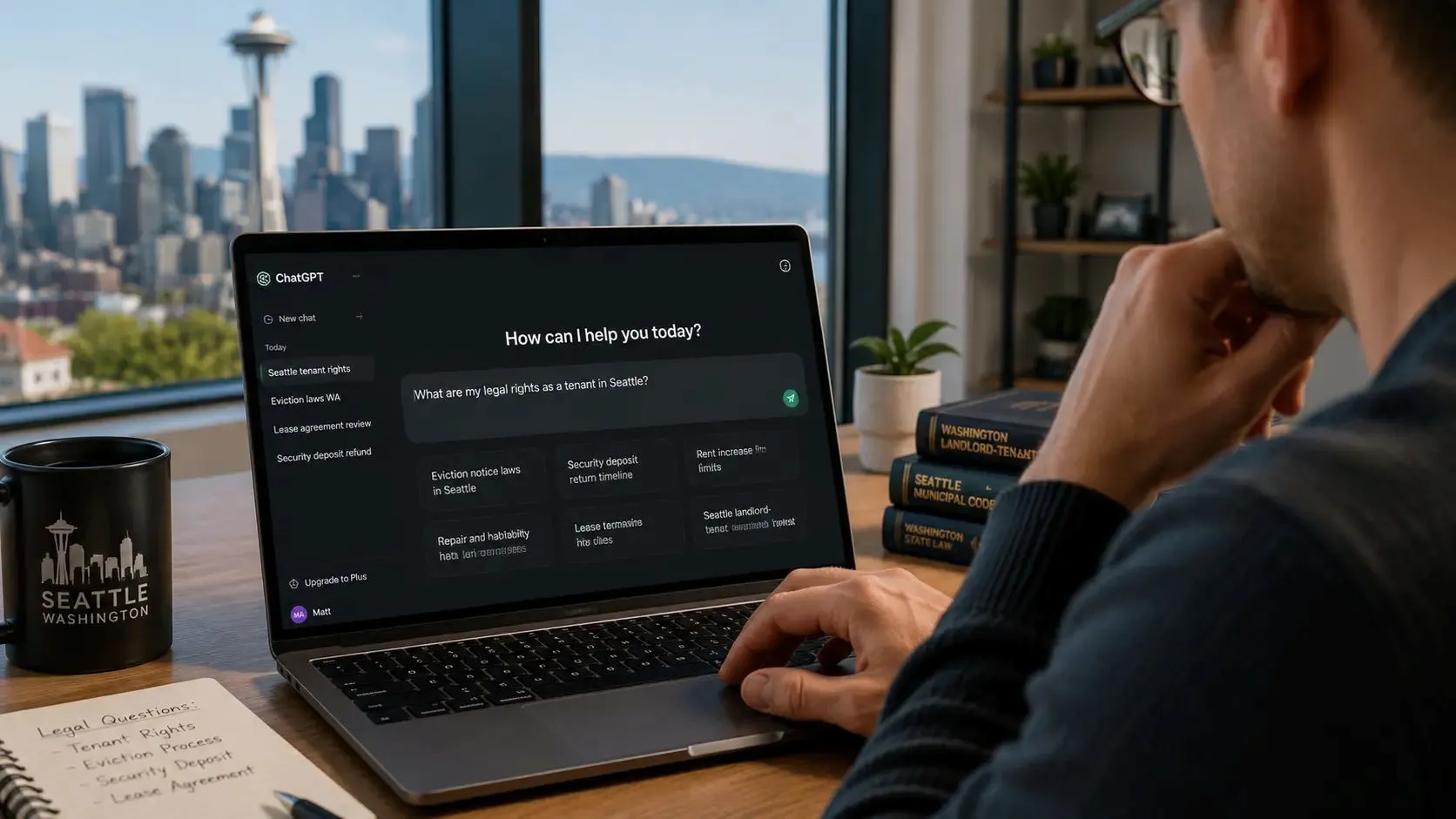
They ask ChatGPT, “What should I do if my landlord is withholding my deposit in Seattle?” They ask Google’s AI Overview, “How much does a DUI attorney cost in King County?” They ask Perplexity, “Who are the best employment lawyers in Seattle for wrongful termination?”
These aren’t searches. They’re conversations. And AI answers them directly, with a name, a summary, and sometimes a phone number, before the person ever reaches a list of blue links.
The shift is measurable. Nearly 78% of legal search queries now trigger an AI Overview, the highest rate of any industry. In Seattle, where tech adoption runs ahead of most U.S. cities, that number skews even higher. Your potential clients are comfortable talking to AI. They trust it. And right now, AI mostly isn’t recommending you.
Why AI Overviews Are Intercepting Your Seattle Leads Before They Reach You
Here’s what happens when someone on Capitol Hill searches “Seattle tenant rights attorney”: Google’s AI pulls from sources it considers authoritative content that directly answers the question, is structured clearly, and comes from a site with consistent, credible signals.
It builds a summary. It might mention one or two firms. It might mention a directory. And then it gives the user exactly enough information to make a call without clicking anything.
That’s called a zero-click search. In 2026, about 60% of all Google searches ended without a single click. When an AI summary appeared, users clicked a traditional result only 8% of the time. Your beautiful, well-optimized practice page? Invisible.
It’s not that people stopped needing Seattle attorneys. They’re just finding them differently now. And the attorneys they’re finding are the ones whose content AI decided to trust.
The Directory Problem: Why Avvo and FindLaw Keep Beating Seattle Attorneys in AI Results
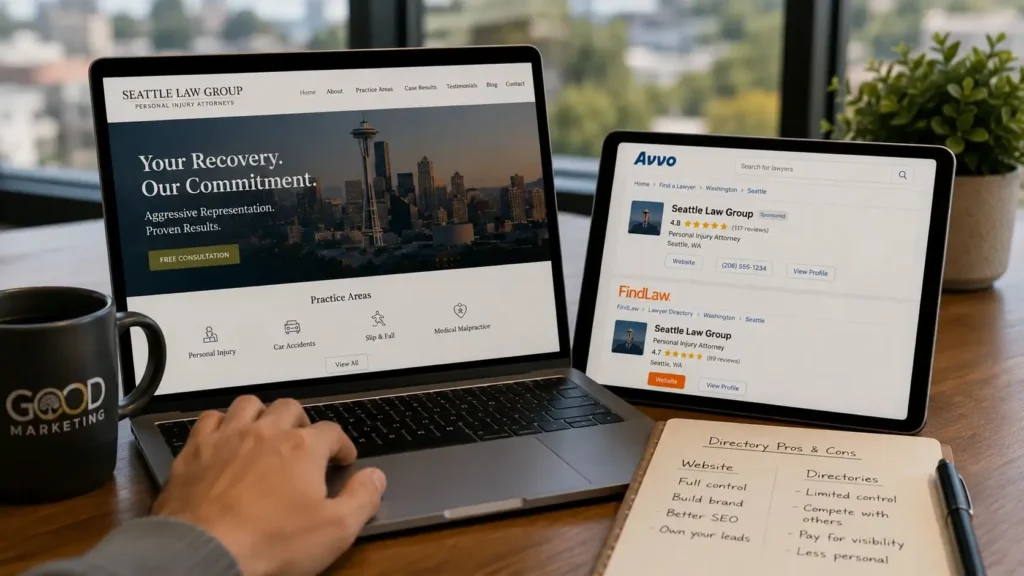
Ask ChatGPT right now: “Best Seattle family law attorney”. Odds are you’ll see a Martindale profile, an Avvo listing, a FindLaw directory page, before you see a single actual law firm website.
Why? Because legal directories have thousands of pages, millions of backlinks, and years of authority signals that tell AI systems: this source is credible. They’ve essentially built an infrastructure designed to sit between you and your clients, and it works even better in the AI era than it did in traditional search.
The directory cartel isn’t just winning Google rankings. They’re winning the AI citation layer. And every lead they capture is a lead you paid to generate through your SEO, your reviews, your reputation, and handed to a middleman.
The only way out is to build your own authority infrastructure so strong that AI systems start citing your website instead of a directory that charges you to exist on it.
How Seattle Attorneys Get Back Into the AI Answer Layer
This isn’t about scrapping what you’ve built. Your existing SEO foundation still matters; strong traditional rankings actually improve your AI citation likelihood because the authority signals overlap. What you’re doing is adding a second layer on top of what already works. Here’s what that looks like specifically for Seattle attorneys.
Write Content That AI Actually Cites, The Answer-First Format
Most law firm content is written for a reader who has time. It buries the answer. It starts with history, context, and disclaimers. AI doesn’t have patience for that. It wants the answer in the first one or two sentences, then depth behind it.
Compare these two approaches:
Old format: “If you’ve been involved in a car accident in Seattle, you may be wondering about your options. Washington is an at-fault state, which means…”
AI-citation format: “In Washington State, car accident victims can file a personal injury claim against the at-fault driver. Seattle drivers have three years from the date of the accident to file; missing this deadline permanently bars recovery. Here’s what that process looks like step by step…”
The second version answers the question immediately, names the jurisdiction (Seattle, Washington State), and signals depth. AI systems reward exactly this structure.
Every practice area page on your site should answer the most common question in the first paragraph. Every blog post should lead with the conclusion. Think of it as writing for someone who only reads the first two sentences, because increasingly, that’s the AI pulling your content into an answer.
And go specific. Not “we handle personal injury cases in Washington.” Try: “Our Seattle attorneys handle car accidents, rideshare injuries (Uber and Lyft cases in King County), and pedestrian accidents on routes like Aurora Avenue and Rainier Avenue South, where collision rates consistently rank among the city’s highest.” That level of local specificity is what separates a page AI trusts from a page AI skips.
Need help restructuring your practice pages for AI citation? The Good Marketing Team builds legal content that answers the questions Seattle clients are actually asking, and formats it so AI systems cite it first.
Local Authority Signals That Tell AI You Serve Seattle
AI systems don’t just read your content. They cross-reference your entire online presence to decide if you’re a legitimate, active, locally relevant business. If your signals are inconsistent or thin, they skip you, even if your content is excellent. This means:
Your Google Business Profile needs to be treated like a second website. Practice areas should be listed explicitly and consistently. Your address needs to match everywhere, your site, your GBP, your bar association listing, your Avvo profile (yes, keep it updated even if you resent them). Seattle-specific service descriptions like “serving King County, Pierce County, and Snohomish County” matter because AI uses geographic entity matching to connect attorneys to locations.
Washington State Bar Association listing. This is a verified, authoritative source. AI systems cross-reference WSBA listings when deciding if an attorney is credible. Your WSBA profile should link to your website, reflect your current practice areas, and match the information on your site exactly.
Local citations with context. Being mentioned in the Seattle Times, cited by a local legal blog, quoted in a South Seattle Emerald piece on tenant rights, these are the “real-world activity signals” AI systems increasingly reward. It’s not just about links. It’s about your name appearing in local, credible sources as an expert voice.
Reviews that mention your practice area and location. “Great Seattle DUI attorney” is more useful to AI systems than “highly recommend”. When clients leave reviews, the ones that mention the type of case and the Seattle area give you geographic + topical relevance in the same signal. You can’t fake this, but you can ask for it specifically.
Schema Markup, E-E-A-T, and Why Your Attorney Bio Page Is Your Secret Weapon
Most Seattle law firm websites have an “About” page and short attorney bios. These are being completely wasted.
Your attorney bio is one of the highest-leverage pages on your site for AI visibility. Because AI systems are trained to prioritize E-E-A-T, Experience, Expertise, Authoritativeness, Trustworthiness. Your bio is where you prove all four. But a photo, a law school name, and three practice bullets don’t do it.
A strong Seattle attorney bio for AI visibility includes:
- Years of practice in Washington State (not just “years of experience”)
- Specific case types handled in King County or the broader Seattle metro
- Bar admissions with links to WSBA verification
- Named results where ethically permissible (“secured a $1.2M settlement for a Bellevue construction worker”)
- Local community involvement, King County Bar Association, WSBA sections, pro bono work in Seattle
This isn’t vanity. It’s data. AI systems read your bio and use it to decide if your firm is worth citing when someone asks who the best Seattle employment attorney is.
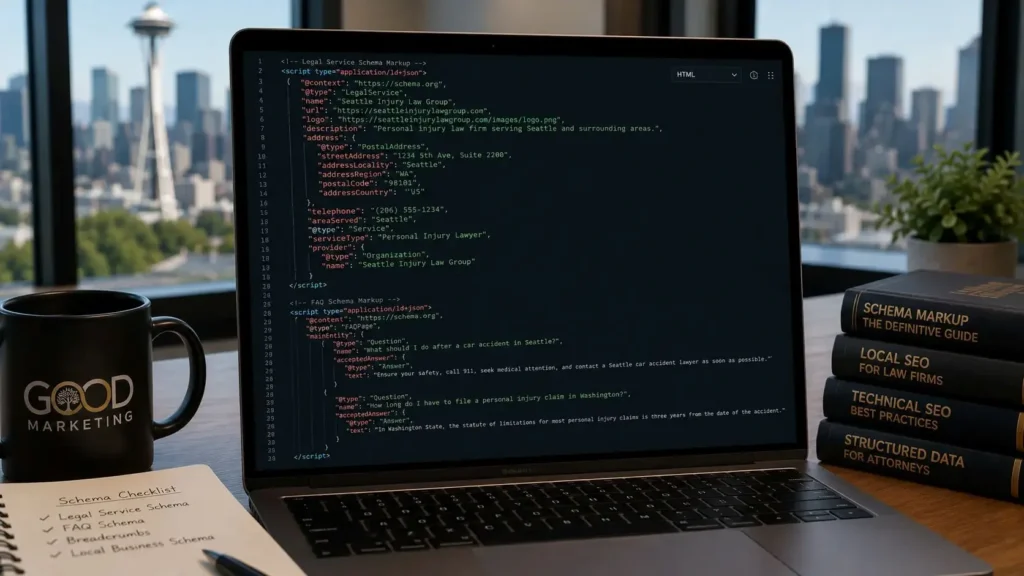
On the technical side, implement Attorney schema markup on every attorney page. Use Legal Service schema on your practice area pages. Add FAQ Page schema to any page with questions and answers. These aren’t optional anymore, they’re the difference between being parsed correctly and being ignored.
Getting Cited on ChatGPT, Perplexity, and Google AI Overviews as a Seattle Attorney
These platforms have different personalities. Understanding them matters.
Google AI Overviews are most likely to cite you when your content directly matches a high-intent query, you have structured data implemented correctly, and your site has consistent E-E-A-T signals across the board. For Seattle attorneys, this means practice area pages that answer specific questions (“How long does a Seattle divorce take?” “What is the penalty for a first DUI in Washington State?”) — not generic pages that describe what you do.
ChatGPT trains on a broad corpus and updates based on browse-enabled queries. It tends to cite firms that appear in multiple credible sources, directories, bar association sites, local news mentions, and legal blogs. A Seattle attorney who has been quoted in a Seattle Times piece about renters’ rights and also has a detailed WSBA listing and a well-structured website is far more likely to surface in ChatGPT than one who only has a good Google ranking.
Perplexity is heavily citation-forward, it shows sources. It tends to pull from pages that answer conversationally and directly. FAQ-structured content performs well here. If you have a page that asks and answers “What should I do after a car accident in Seattle?” in clear, accessible language, Perplexity is more likely to cite it than a dense, jargon-heavy practice area page.
The common thread across all three: depth, specificity, and local grounding. A page that answers one Seattle-specific question better than anyone else on the web will beat a page that answers ten questions generically. Every single time.
AI Search Is Redirecting Leads
AI search isn’t a future problem and the firms that move first will own the citation layer for years. The ones that wait will fund the ones that didn’t.
The good news? Most Seattle law firms haven’t made this move yet. The local content gap is wide open. Your competition is still publishing the same generic “what is personal injury law” blog posts that AI systems learned to ignore. You don’t have to be everywhere. You just have to be cited by the right platforms, for the right Seattle-specific queries, at the moment your next client is asking.
That’s exactly the kind of strategy we build at The Good Marketing Team. Not templates. Not recycled content. Real, locally-grounded authority that gets you into the answer layer.
Ready to stop losing Seattle leads to AI? Let’s talk with The Good Marketing Team. Our team builds legal content strategy for attorneys who want to rank on Google, get cited by AI, and turn visibility into clients.
FAQs
Frequently Asked Questions
1. How do I get my law firm cited in Google AI Overviews?
To get cited in AI Overviews, create answer-first content that directly addresses client questions, implement proper schema markup, strengthen attorney bios, and build local authority signals through reviews, citations, and trusted legal sources.
2. Why is my law firm ranking on Google but getting fewer leads?
Many legal searches now end with AI-generated answers before users click websites. Your rankings may remain strong, but AI Overviews, ChatGPT, and Perplexity can intercept potential clients before they reach your site.
3. Can ChatGPT recommend my law firm to potential clients?
Yes. ChatGPT often references law firms with strong online authority, detailed attorney profiles, consistent local signals, media mentions, and content that clearly answers legal questions.
4. What type of content performs best in AI search results?
AI platforms prefer content that answers questions immediately, uses clear formatting, includes local context, demonstrates expertise, and provides comprehensive information on a specific topic.
5. Does local SEO still matter in the AI search era?
Absolutely. AI systems rely heavily on local signals such as Google Business Profiles, Washington State Bar listings, local reviews, geographic keywords, and mentions from trusted Seattle publications.
6. How important is schema markup for attorney websites?
Schema markup helps AI systems understand your attorneys, practice areas, FAQs, and legal services. Proper implementation improves the chances of your content being cited and surfaced in AI-generated answers.
7. How can Seattle attorneys compete with Avvo and FindLaw in AI search?
The best strategy is to build your own authority through high-quality content, strong E-E-A-T signals, local citations, attorney-specific expertise pages, and structured data that AI systems can easily understand.
8. What is the fastest way to improve AI visibility for my law firm?
Start by optimizing your highest-value practice area pages, improving attorney bio pages, adding FAQ sections, implementing schema markup, and creating Seattle-specific legal content that answers real client questions.
9. Do attorney bio pages affect AI citations?
Yes. Attorney bios are one of the strongest E-E-A-T signals. Detailed bios showcasing experience, practice areas, case results, bar memberships, and community involvement can significantly improve AI trust and visibility.
10. Should law firms create separate content for ChatGPT and Google AI Overviews?
No. The best approach is to create authoritative, well-structured content that serves both users and AI systems. Strong answer-first content performs well across Google AI Overviews, ChatGPT, Perplexity, and traditional search.