

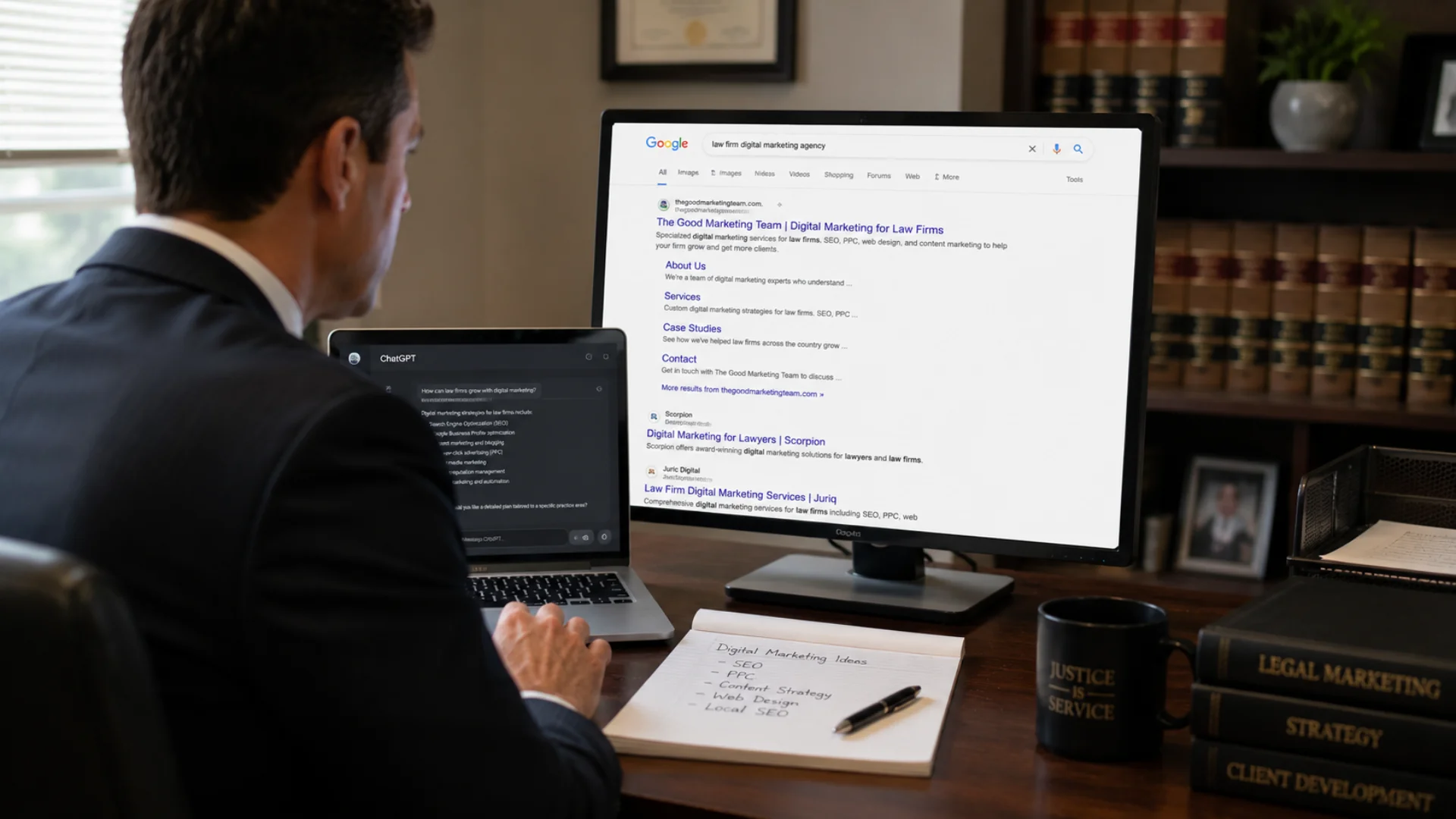
Most personal injury attorneys searching for an AI ranking agency in 2026 are asking the wrong question. They’re asking “who’s the best?” when they should be asking “what does good actually look like, and how do I verify it before I sign anything?”
Because the firms getting cited by ChatGPT and Google AI Overviews right now aren’t necessarily the biggest spenders or the most established names in your market. They’re the ones whose digital presence was built to be readable by AI, structured, locally grounded, attorney-attributed, and specific enough that an LLM trusts it as a source. That’s a solvable problem.
But only if you know exactly what to look for, and what to demand proof of, before you hand anyone your marketing budget.
What “AI Ranking” Means for Personal Injury Attorneys in 2026 (And What It Doesn’t)
Before you evaluate a single agency, you need to be clear on what you’re actually buying. Because right now, the term “AI SEO” is being used to sell three completely different things, and only one of them moves the needle for personal injury firms.
The Difference Between SEO, GEO, and AEO, And Why Personal Injury Attorneys Need All Three
Traditional SEO gets your website onto page one of Google. That still matters. But it was built for a world where someone typed “car accident lawyer Los Angeles”, scanned a list of ten blue links, and clicked. That behavior is declining fast.
GEO (Generative Engine Optimization) is the discipline of getting your firm cited in AI-generated answers. When someone asks ChatGPT, “What should I do after a hit-and-run accident in Texas?” and ChatGPT responds with an explanation that mentions your firm or links to your content, that’s GEO working. You didn’t rank. You were referenced as a trusted source.
AEO (Answer Engine Optimization) is a subset of GEO focused specifically on structured answers. Think FAQ schema, People Also Ask boxes, Google AI Overviews. It’s the difference between your content getting scraped and summarized (without credit) and your firm’s name appearing in the generated answer with a citation.
Personal injury is, by a significant margin, the practice area where this matters most. Over 75% of personal injury search queries now trigger a Google AI Overview. That’s not a projection, it’s the current rate, the highest of any legal practice area. And according to a LawFuel analysis from January 2026, 64% of law firms have zero AI search visibility at all. They’re not showing up in ChatGPT, Claude, or Perplexity. Not even once.
The right agency needs to be operating across all three layers, traditional search, AI citations, and structured answer formats, simultaneously. Any agency pitching you “AI SEO” that can only speak to one of these is telling you something important about their limitations.
Why Personal Injury Is the Highest-Stakes Practice Area for AI Visibility
The nature of personal injury clients makes AI search more critical in your practice area than in almost any other.
When someone needs a personal injury attorney, the triggering event was traumatic and recent. A car accident at 11 PM. A slip and fall at a grocery store. A workplace injury. They’re not casually browsing; they’re scared, in pain, and searching on their phone from an ER waiting room or sitting in their car after the adrenaline wears off. They ask AI tools conversational questions because they’re not sure what they’re even looking for yet. “Do I need a lawyer if the other driver’s insurance already called me?”, “How long do I have to file a personal injury claim in Florida?” “What’s a fair settlement for a broken collarbone after a car accident?”
If your firm’s content isn’t the source AI pulls from to answer those questions, you don’t exist in that moment. The firm that is cited gets the call. Because they were structured to be found by AI at the exact moment someone needed them. That’s the mission your agency should be solving for. And most of them aren’t.
How to Choose the Best AI Ranking Agency for Your Personal Injury Law Firm
Here’s the actual evaluation framework, the questions, the proof points, and the red flags that separate real AI ranking agencies from expensive impostors.
The 5 Questions You Must Ask Every Agency Before Signing a Contract
Most agencies will impress you in a sales call. The ones worth hiring will also impress you when you push back. Ask these five questions directly and pay close attention to how they respond, not just what they say.
Question 1: “Show me a personal injury firm you’ve gotten cited in ChatGPT or Perplexity. Right now, in this call.”
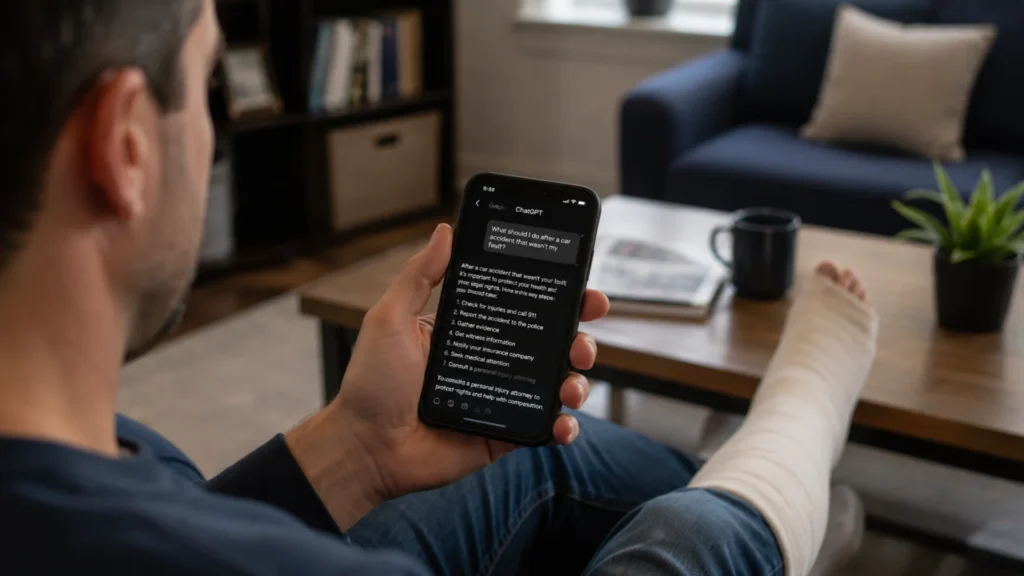
This is the fastest filter. If they can’t open a browser, ask ChatGPT a relevant personal injury question, and show you a client citation appearing in real time, they haven’t done the work. Screenshots are easy to fake and cherry-pick. Live demonstrations are not.
Question 2: “What’s your process for tracking AI citation share-of-voice, and how often do you report it?”
Traditional SEO reports rank positions and organic traffic. That’s not enough anymore. A serious AI ranking agency tracks how frequently your firm appears in AI-generated answers for target queries, across ChatGPT, Perplexity, Google AI Overviews, and Gemini. This is called citation share-of-voice, and it’s the metric that actually tells you if the AI visibility work is compounding. If an agency can’t explain how they measure this, they’re not measuring it.
Question 3: “How do you handle attorney-authored content and E-E-A-T verification?”
AI systems, especially since Google’s 2025 Helpful Content updates, significantly weigh content that demonstrates real, verifiable human expertise. For personal injury attorneys, this means content that includes jurisdiction-specific legal accuracy, attorney attribution, bar information, and case experience. Generic AI-generated articles published under your name without substantive attorney input will actively hurt your visibility. Ask the agency how attorney expertise gets embedded into every piece of content they create.
Question 4: “What’s your schema implementation process for personal injury firms specifically?”
The right answer involves LegalService schema on practice area pages, Attorney schema on bio pages, FAQPage schema on any page with structured Q&A, and LocalBusiness schema with consistent NAP signals. If they give you a vague answer about “structured data”, they’re not implementing it with any precision. Personal injury firms need a schema that maps practice areas (car accidents, truck accidents, slip and fall, medical malpractice) to specific service areas and jurisdiction, not a generic legal schema copied from a template.
Question 5: “What do you do differently for personal injury versus other practice areas?”
This question exists to surface whether the agency treats PI as a distinct vertical or just another legal client. Personal injury has unique characteristics like high competition, high CPCs, emotionally-driven search behavior, state-specific statute of limitations content, and insurance company counter-positioning that other practice areas don’t have.
An agency that can’t articulate a PI-specific strategy is running the same playbook for you as they run for an estate planning firm in a small market. That’s a problem.
What Real AI Ranking Results Look Like for Personal Injury Firms
Agencies love to show traffic charts. Here’s what actually matters:
AI citation frequency
How often does your firm appear when a relevant personal injury query is asked across ChatGPT, Perplexity, and Google AI Overviews? This should be tracked weekly, per query cluster, per geography.
AI referral conversion rate
This is the number that should get your attention. AI-referred visitors convert at roughly 4.4 times the rate of standard organic visitors. That’s not a minor difference. One AI citation that sends 50 visitors a month can outperform a top-10 ranking that sends 500 visitors who bounce. Your agency should be tracking this specifically.
Zero-click impression share
For queries where your content feeds an AI Overview but the user doesn’t click, you still want brand mention data. Are users seeing your firm name in the answer layer, even if they don’t visit your site? Repeated exposure to AI answers builds recall that shows up in direct searches later.
Case inquiry volume and quality
At the end of the day, you’re not buying rankings. You’re buying phone calls from people who were in accidents. Your agency should be tying its work to case inquiry volume and case type, not vanity metrics.
A real agency shows you a dashboard with all of these. A fake one shows you a keyword ranking report and calls it AI optimization.
6 Red Flags That Should End a Conversation Immediately
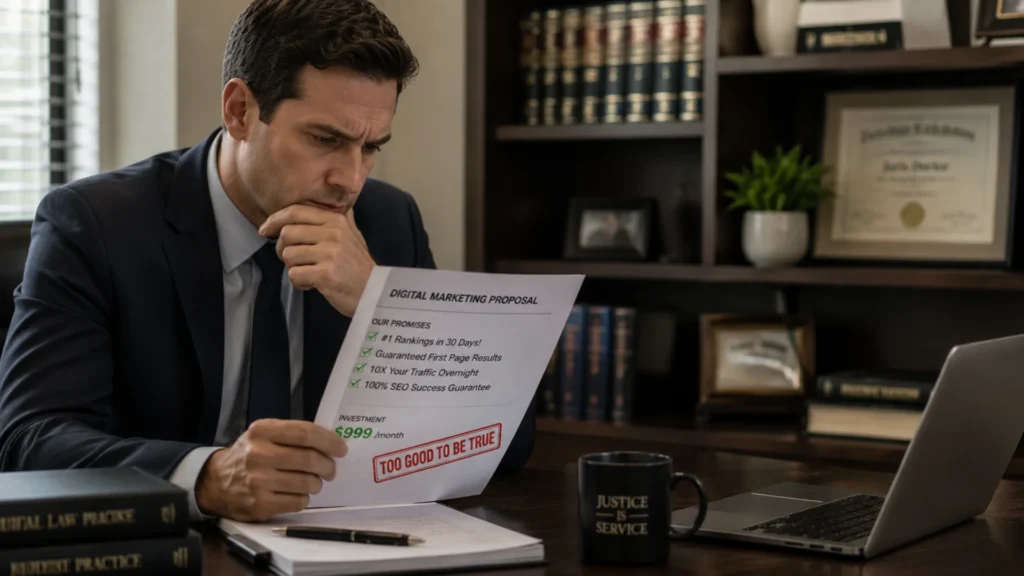
You don’t have time to waste on bad agencies. These are the signs you’re in one:
- They lead with volume. “We’ll publish 20 blog posts per month”. Volume without an AI-citation strategy produces content that feeds AI without crediting your firm. You want cited, not just scraped.
- They can’t explain topical authority. Getting cited by AI systems requires owning a topic cluster, a set of interlinked, deeply informative pages around specific injury types that establishes your firm as the authoritative source on that subject. If an agency pitches individual blog posts without a topical architecture plan, they’re doing 2019 SEO.
- They promise page-one rankings with a timeline. Real AI visibility compounds over weeks and months, not in 30 days. Anyone promising fast AI citation results is either lying or selling you something different from what they’re describing.
- They don’t ask about your practice areas, jurisdictions, and case types before pitching. A car accident attorney in Phoenix has a completely different AI visibility opportunity than a medical malpractice firm in New York. An agency that pitches you a generic plan before understanding your geography and case mix doesn’t have a plan, they have a template.
- They use AI to write everything without attorney review. AI-generated content that isn’t reviewed and validated by a real attorney is increasingly penalized by AI systems themselves. Google’s systems and LLMs are getting better at detecting unreviewed AI output. Content that lacks verifiable legal accuracy and attorney attribution is not going to earn citations. It’s going to get ignored.
- Is your personal injury firm invisible to AI right now? The Good Marketing Team audits PI firms’ AI citation share-of-voice across ChatGPT, Perplexity, and Google AI Overviews, and builds the content infrastructure to change it.
What the Best AI Ranking Agency for Personal Injury Attorneys Actually Does
Here’s what a legitimate, high-performance AI ranking agency is doing behind the scenes for a personal injury client:
Building jurisdiction-specific topical authority. Not one page about “car accident claims”. A full cluster, the main page, plus supporting pages on trucking accidents, rideshare accidents (Uber/Lyft), pedestrian accidents, hit-and-run claims, insurance bad faith, statute of limitations by state, all interlinked and all structured to answer the exact questions AI systems get asked. Each piece is attributed to a real attorney, written with legal accuracy, and formatted to answer the primary question in the first two sentences.
Implementing LLM-friendly content architecture. This means answer-first structure, FAQ schema on every relevant page, clear entity signals (firm name, attorney names, practice areas, geographic service areas all appearing consistently and correctly), and internal linking that helps AI systems understand the relationship between your pages.
Running AI visibility audits monthly. Testing 50–100 target queries across ChatGPT, Perplexity, Google AI Overviews, and Gemini. Documenting which queries your firm appears in, which competitors appear instead, and where the citation gap is largest. Using that data to prioritize content updates.
Building external authority signals. Getting your firm’s attorneys quoted in local news, contributing to legal publications, ensuring WSBA/state bar profiles are complete and linked to your site, and monitoring directory presence across Avvo, Martindale, and FindLaw, not as a primary strategy but as a cross-reference signal that AI systems use to verify your legitimacy.
Tracking what actually matters to a PI firm. Not impressions. Not click-through rates. Case inquiry volume, case type distribution, and geographic coverage of incoming inquiries, all tied back to specific content and AI visibility improvements.
Build Your Personal Injury Attorney Brand Strongly
The personal injury market is one of the most competitive legal niches in digital marketing. It always has been. But the competition has fundamentally changed in 2026; it’s no longer about who has the biggest advertising budget or the most backlinks. It’s about whose firm name appears when a scared person asks an AI tool for help at midnight after an accident.
The agency that gets you there isn’t the one with the most impressive sales deck. It’s the one that can show you a real citation in a live demo, explain a jurisdiction-specific topical strategy for your practice areas, and report on AI share-of-voice every single month. That’s the standard. Anything less is the old game dressed up in a new language.
At The Good Marketing Team, we build AI citation infrastructure for personal injury attorneys who are done watching their leads go somewhere else. Ready to find out where your firm stands in AI search? Let’s start with an audit or book a consultation call with The Good Marketing Team.
FAQs
- What is an AI ranking agency for personal injury attorneys?
An AI ranking agency for personal injury attorneys optimizes your firm’s digital presence to appear in AI-generated answers on platforms like ChatGPT, Google AI Overviews, Perplexity, and Gemini, not just traditional Google search results. This includes GEO (Generative Engine Optimization), structured data implementation, attorney-attributed content strategy, and AI citation tracking.
- How long does it take to see AI search results for a personal injury law firm?
AI citations can appear within weeks for well-structured content on high-authority domains. For most personal injury firms starting from a low AI visibility baseline, meaningful citation frequency typically builds over three to six months as topical authority compounds. Agencies promising results in under 30 days should be approached with caution.
- What’s the difference between GEO and SEO for personal injury lawyers?
Traditional SEO gets your website ranked on Google’s search results pages. GEO (Generative Engine Optimization) gets your firm cited inside AI-generated answers, where your name appears in ChatGPT’s response, not just a list of links. In 2026, both matter, but AI citations convert at significantly higher rates than standard organic traffic for personal injury queries.
- How do I know if an AI ranking agency is actually getting results?
Ask them to show you live AI citations for current clients during the sales call. Ask for citation share-of-voice reports, not just keyword ranking data. A legitimate AI ranking agency tracks how often your firm appears in AI answers for target queries across multiple platforms, and can show you that number going up over time.
- Why do personal injury attorneys need AI-specific marketing in 2026?
Over 75% of personal injury search queries now trigger a Google AI Overview. Potential clients are asking AI tools conversational questions immediately after accidents, before they ever look at a list of attorney websites. If your firm isn’t being cited in those AI answers, you’re invisible at the highest-intent moment in the client decision process.